(This blog summarizes a webinar. You can watch that webinar here.)
Most companies do not have an AI tooling problem anymore.
The models are available. The copilots are everywhere. “Using AI” is quickly becoming table stakes.
The harder shift is structural. AI changes how work flows through an organization, how decisions get made, and what “good” looks like when execution is cheap. Hiring matters, but it is downstream of a bigger operating model change.
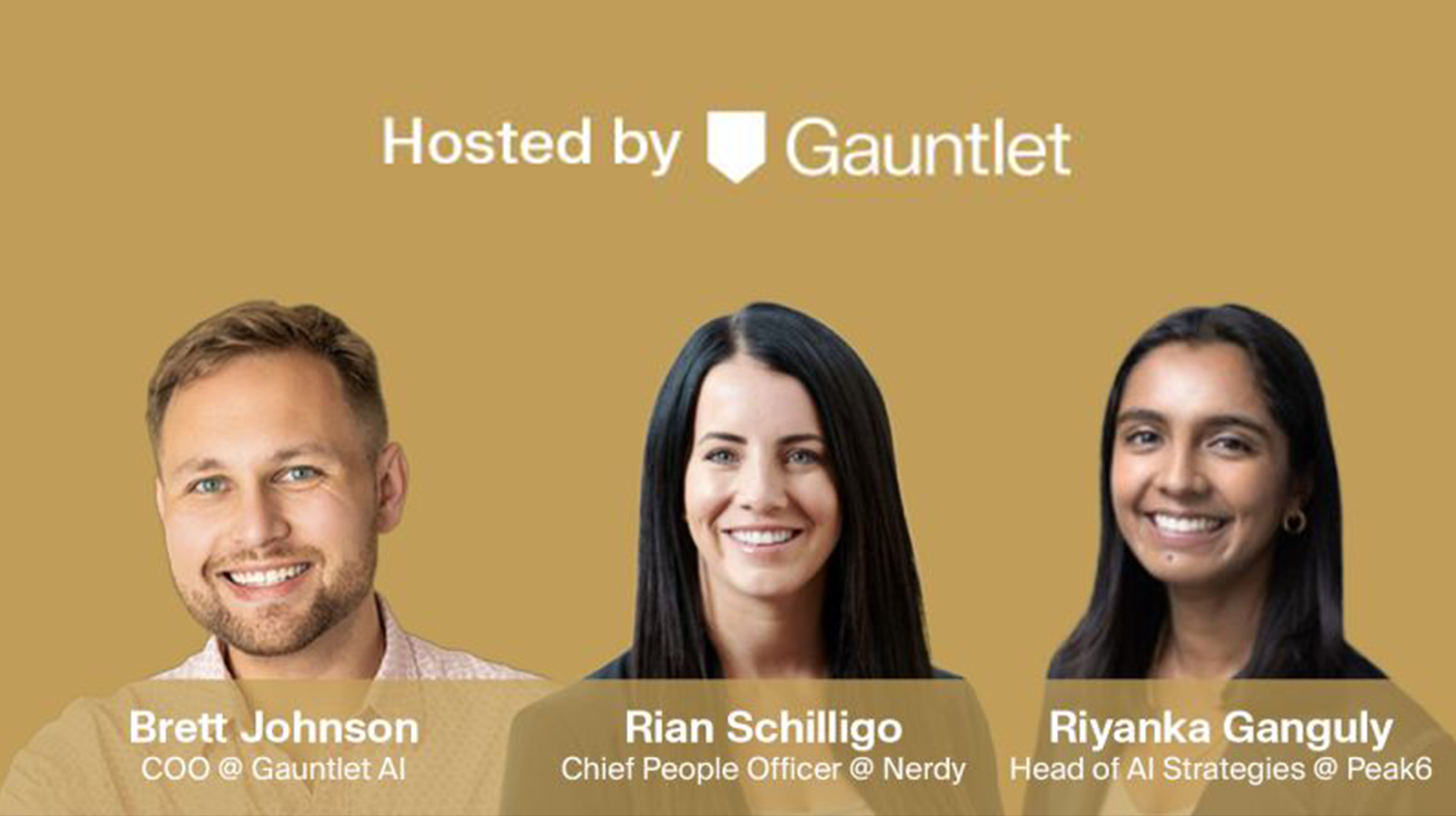
In a conversation hosted by Brett Johnson, COO of Gauntlet, two leaders building inside that reality shared what they are seeing firsthand:
- Riyanka Ganguly, Head of AI Strategies at PEAK6
- Rian Schilligo, Chief People Officer at Nerdy
PEAK6 is a fintech operator behind major infrastructure like Apex. Nerdy (NYSE: NRDY) is the leading curated platform for personalized live online learning. Led by their flagship business, Varsity Tutors, they leverage technology and AI to deliver personalized live learning at scale. Both are Gauntlet hiring partners, and both are actively adapting their teams to operate AI-first.
Here are the three takeaways that matter most for CEOs, Heads of People, and CTOs heading into 2026.
Takeaway 1: When shipping is cheaper and easier, judgment determines whether speed creates value or waste.
AI makes it easier to produce output, but it does not make it easier to make the right calls.
That is why the best teams are shifting their definition of “great talent.” The question is no longer whether someone can build quickly. It is whether they can decide what to build, validate it, and ship something that holds up in production.
Rian captured the shift in one line:
“In an AI enabled world that we're in right now, output is cheaper, but good decisions are not.”
Riyanka described how this shows up in hiring: teams have to look past the surface-level polish and test for production thinking.
“You could kind of tell when someone built a nice, pretty UI, but they hadn’t thought through the data infrastructure or the engineering it would take to support it at production scale.”
That one observation explains why so many AI demos fail inside real companies. It is easy to create something impressive. It is harder to make something reliable, scalable, and measurable.
What this means for companies: If your team structure and hiring process still reward output over judgment, you will move faster, but not necessarily in the right direction.
Takeaway 2: Resumes and coding screens are losing signal, and work simulations are replacing them.
When output is easier to generate, the traditional hiring process breaks in predictable ways. Resumes become easier to inflate. Take-home projects become harder to trust. Coding tests become less relevant to real work.
The gap is not just that candidates can produce more output. It is that some hiring teams cannot reliably tell how the output was produced or whether it will hold up in production. Riyanka was direct about what has already changed:
“You need to have people in the room who are actually AI-native. Otherwise, the work can seem almost magical to someone who doesn’t fully understand what’s happening underneath.”
If the goal is to hire people who can ship AI-powered systems in the real world, you need to evaluate them in conditions that resemble the real world.
Rian described where hiring is moving instead:
“Hiring is moving more towards work simulations, real world problem solving.”
Both PEAK6 and Nerdy emphasized that the only reliable way to evaluate AI-native talent now is to watch how people operate under real conditions: ambiguous problems, real constraints, and work that has to hold up beyond a demo, which is exactly what Gauntlet’s partner projects are designed to surface.
Instead of trying to infer ability from credentials or interviews, they want to observe how candidates think, iterate, and ship.
What this means for companies: If your hiring process has not changed in the last 12–18 months, it is likely selecting for the wrong signals, even if your team is “using AI.”
Takeaway 3: “AI-enabled” vs “AI-native” is the real divide, and speed is the tell
The biggest misconception in hiring right now is thinking the key differentiator is whether someone “uses AI.” The tell is the same one everywhere: can the team ship, or only demo? AI-enabled organizations have people who use AI tools. AI-native ones have people who build production AI. Speed is what that difference looks like from the outside.
In 2026, almost everyone will say yes.
The real difference is whether someone is AI-enabled or AI-native. AI-enabled people use tools to move faster. AI-native people restructure how work gets done because the tools exist.
Rian gave the cleanest definition of the gap:
“AI-enabled people use AI to do the same job they do, but faster.”****“AI-native people are redesigning the job because AI exists.”
That distinction matters because it predicts impact. AI-native hires do not just contribute. They create leverage. They make the team around them faster.
Riyanka went a step further and connected speed directly to org design. AI-native talent expects to move quickly not as a perk, but as a necessity.
“Speed is important because AI is changing so much,” she explained. “The types of people we're bringing in are going to get bored if there is no speed.”
In practice, that means building systems that remove friction rather than adding process. “You have to create a system that allows for people to just run with things,” she said. In an environment where the pace of change is daily, slowing people down is not neutral. It actively pushes your best talent away.
This is where org design becomes inseparable from hiring. AI-native talent expects a different pace, fewer bottlenecks, and broader ownership.
And it’s why Gauntlet shows up as more than “talent”: the companies in this conversation weren’t just looking for people who can say the right things about AI. They were looking for people who have already proven they can operate at that pace — shipping weekly, taking ownership, and using AI as leverage without hiding behind it.
What this means for companies: Becoming AI-first is not just about recruiting different people. It requires building an environment where those people can operate at full speed.
The bigger picture: becoming AI-first is an operating model shift
These takeaways point to a simple conclusion.
Becoming AI-first in 2026 is not a tooling rollout. It is a change in:
- what you reward
- how you structure teams
- how you evaluate candidates
- how quickly you expect leverage
That is why companies like PEAK6 and Nerdy partner with Gauntlet. When the old signals break, you need a way to evaluate talent through real work, real deadlines, and real ownership.
PEAK6 and Nerdy both partner with Gauntlet to hire engineers who've proven they can ship under real conditions. → Hire AI-native engineers.
Frequently Asked Questions
What's the difference between AI-enabled and AI-native?
AI-enabled people use AI to do the same job faster; AI-native people redesign the job because AI exists. The second creates leverage for the whole team, not just individual speed.
What does it mean to become AI-first?
It's an operating-model shift, not a tooling rollout — changing how you hire, structure teams, and remove friction so AI-native people can move at full speed.