A Chief AI Officer (CAIO) owns the business value your organization gets from AI — strategy, governance, and the capability to ship AI into production. It's not a CTO with a new title, and it's not a strategy seat. Here's what the role actually requires, when you need one, and the hiring profile that succeeds.
Most companies transitioning to AI-first are at a crossroads around governance. Many have decided this strategic imperative requires a dedicated leader. The CEO is convinced. The board wants a Chief AI Officer. Now you need to hire one.
The problem is that the role is still poorly defined. Is it technical like a CTO? Strategic like a CDO? Hybrid? Most organizations pattern-match from CTO roles—but that's usually a mistake. A CTO is typically optimizing for shipping velocity, engineering execution, and platform reliability. A Chief AI Officer is usually optimizing for business value from AI while balancing governance, organizational alignment, and risk. Those priorities overlap sometimes, but they pull organizations in different directions often enough that the roles tend to require different profiles, incentive structures, and reporting lines.
A lot of organizations hire poorly because they're borrowing mental models from roles that don't map cleanly. The result is often expensive executives who slowly become expensive advisors, unclear decision authority, and frustration from both the executive and the board. Understanding what a CAIO actually does, when you need one (and when you don't), and what the right hiring profile looks like isn't especially complicated—but it is specific. It depends on your organization's maturity, your existing technical depth, and what "AI success" actually means inside your company.
What a CAIO Actually Does (vs. What People Assume)
In practice, most CAIO roles end up centered around three areas: strategy, governance, and value creation. Not research. Usually not engineering execution either. And despite what some organizations hope, they're rarely the person fixing foundational data infrastructure problems.
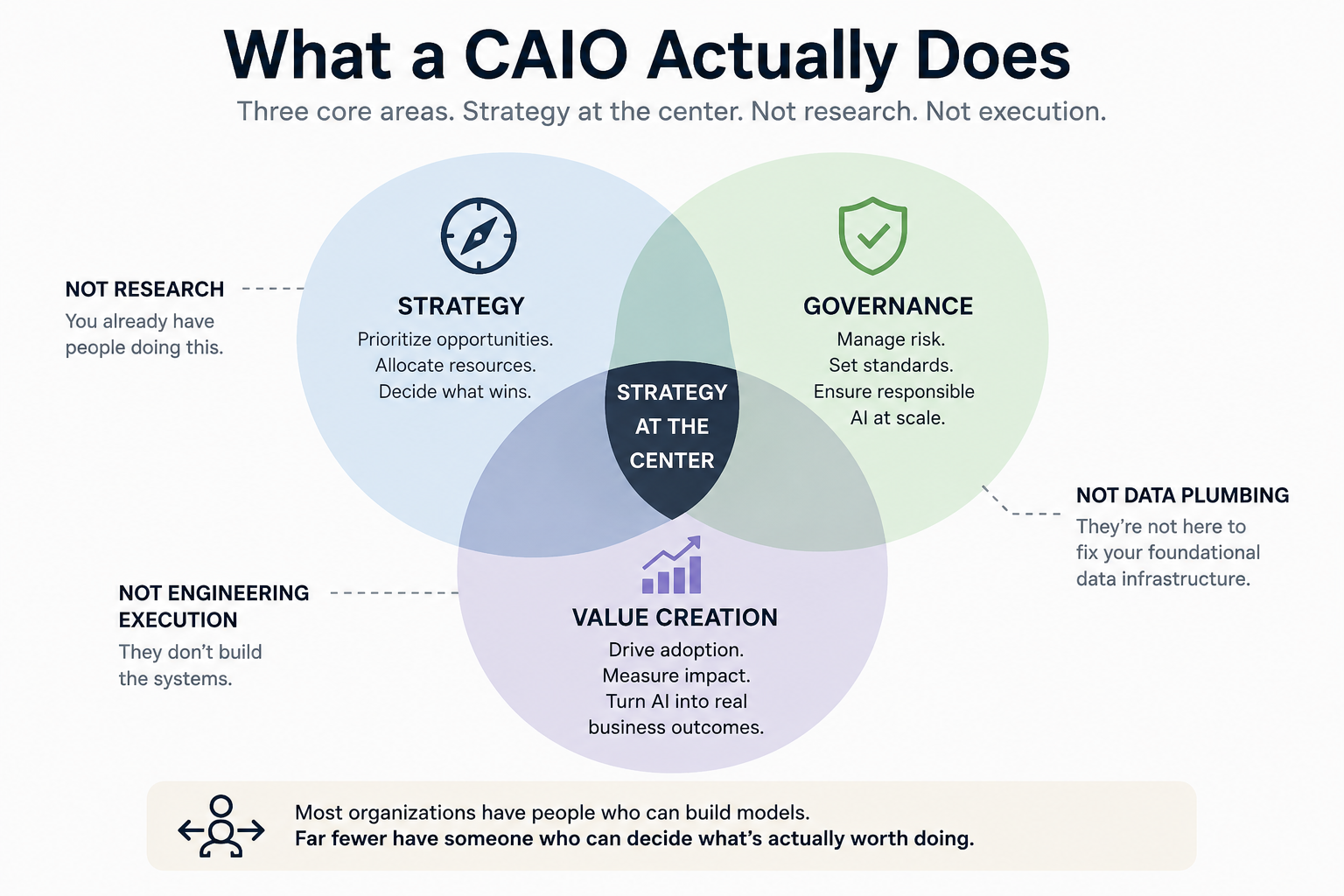
Strategy and portfolio decisions sit at the center of the role. Where does AI actually create value for the business? What problems should the organization solve with AI, and in what order? What initiatives get funded next quarter, and which ones get cut? This usually requires stronger business judgment than pure ML expertise. Most organizations already have people capable of building models. Far fewer have people capable of deciding which AI initiatives are actually worth organizational attention.
A CAIO shapes the AI roadmap and makes prioritization decisions across competing initiatives. This is where tension with CTOs or engineering leadership often surfaces. Engineering organizations naturally optimize toward reliability, delivery timelines, and architectural consistency. AI leadership often ends up optimizing around business leverage, prioritization, and organizational adoption instead. Those incentives align sometimes and collide other times.
Governance and risk management is the second pillar. This includes model inventory, testing standards, monitoring frameworks, incident response, vendor oversight, and compliance. It's less exciting than strategy work, but companies that neglect governance early usually end up rebuilding it later under pressure. A strong CAIO establishes standards for bias testing, drift monitoring, explainability, and ethical use before problems emerge. In regulated industries, this can become the dominant part of the role rather than a secondary responsibility.
Organizational leadership and upskilling is the third. Embedding AI literacy across teams doesn't happen automatically. It means helping product managers understand what's actually possible with AI—and what isn't. It means coaching engineering teams through early deployments. It means explaining limitations to sales teams so they don't oversell capabilities to customers. This upskilling component often requires structured programs tied to real work—the kind of training that embeds learning directly into execution.
A surprising amount of the role is translation. Translating technical constraints to executives. Translating business priorities to engineering teams. Translating regulatory concerns into operational processes. The strongest CAIOs are usually people who can move comfortably between those contexts without losing credibility with either side.
What the role usually isn't: a Head of Data Science focused primarily on model development and research. Not a CTO trying to add AI to an already overloaded portfolio. Not a consultant dressed up as an executive without operational authority. And not a Principal Engineer who codes full-time, even though engineering depth is still valuable.
When You Need a CAIO vs. Alternatives
The CAIO role creates value at specific stages of organizational maturity. For younger organizations—or companies with unusually strong existing technical leadership—alternatives often deliver better return on investment. If you have fewer than 50 engineers and only limited experience shipping AI systems, a full-time CAIO is usually premature. At that stage, the organization's problem is typically execution, not portfolio management. You're still trying to figure out whether the company can reliably ship useful AI systems in the first place.
What you usually need instead is fractional AI leadership or a strong Principal AI Engineer embedded directly in the product organization. You likely don't have enough simultaneous AI initiatives to justify full-time governance and prioritization overhead yet. Bringing in fractional leadership for 6 to 12 months to establish standards, evaluate opportunities, and identify where AI creates leverage is often the better move. Once you've shipped several systems and understand the operational pattern, permanent leadership may start to make sense.
If you have 50 to 200 engineers with multiple AI initiatives running or planned, a full-time CAIO starts becoming more reasonable. Fractional leadership tends to break down once there's enough complexity to require daily prioritization and coordination. Someone working 10–15 hours a week usually can't govern five simultaneous initiatives or make rapid decisions about budget and resource tradeoffs.
In many organizations, CAIOs also tend to work better when they sit close to the CEO or COO rather than inside the engineering org. Once the role reports into the CTO, AI priorities can start drifting toward architecture optimization instead of broader business prioritization. Some companies absolutely make that structure work, but it usually requires unusually strong alignment between technical and business leadership.
If you already have a strong VP of Engineering or CTO who genuinely wants to own AI strategy, you may not need a full CAIO. Instead, hiring a support role—fractional AI advisor, Head of AI Governance, or senior AI product lead—may fill the gaps more effectively.
But this only works if the CTO actually understands AI's operating model. AI systems tend to involve slower iteration cycles, higher uncertainty, lower predictability of outcomes, and more organizational ambiguity than traditional software projects. If leadership approaches AI as "just another engineering problem," this structure tends to fail quickly.
Regulated industries are a different category entirely. In finance, healthcare, defense, insurance, or utilities, governance and compliance requirements alone can justify dedicated AI leadership. At that point, the question shifts away from efficiency and toward accountability, auditability, and risk management. The real question before hiring is simple: what decisions do we need someone making full-time that nobody currently owns clearly?
If the honest answer is still vague, fractional leadership, distributed ownership, or a strong VP-level engineering hire will usually serve the organization better. Hiring a CAIO before the organization has enough AI complexity to justify the role tends to burn cash and frustrate everyone involved.
What the Right Profile Actually Looks Like
The profile varies by organization stage, but the red flags and success signals are surprisingly consistent. One of the more common mistakes is copying a CTO job description, replacing "technology" with "AI," and assuming the same hiring model applies. The same profile gap shows up one level down when you're hiring AI engineers.
What usually works: a track record of executing in unfamiliar business contexts. Has this person shipped AI systems outside pure tech environments? Have they navigated the gap between proof-of-concept and production inside organizations with messy operational realities? Production experience matters more than pedigree here.
Someone who deployed recommendation systems inside a retail company and later helped a manufacturing firm build quality control models often has broader pattern recognition than someone who spent their entire career inside a single Big Tech environment.
Business and technical literacy both matter. The strongest candidates can read a financial model and understand what's technically feasible without oversimplifying either side. That combination is rarer than most organizations expect. And it's different from simply being "technical and business-minded." The real test is whether they can have credible conversations with both sides without losing trust from either.
Decision authority also matters more than many companies realize. Have they actually made binding decisions that changed organizational direction? Or have they mostly operated in advisory capacities? One of the more common failure modes is hiring someone whose instinct is to recommend rather than decide. Good CAIOs kill projects, redirect budgets, challenge timelines, and make uncomfortable prioritization calls when necessary.
Specific depth in at least one AI domain is important too. CAIOs don't need to be researchers, but they should have real experience in an area like LLM systems, computer vision, recommendation systems, forecasting, or ML infrastructure. That depth grounds judgment and makes it harder to oversimplify operational realities.
Communication ability matters enormously. This person will spend a large portion of their time explaining AI limitations, tradeoffs, and possibilities to non-technical stakeholders. Bad communicators usually fail regardless of technical depth.
There are also predictable red flags. Over-indexing on "Led AI at Big Tech" as the primary credential. Academic publishing history used as a proxy for operational ability. Candidates who can code but have never led teams. People who talk about AI constantly but struggle to connect it to measurable business outcomes. Candidates with no governance or risk management exposure in their background.
Background diversity matters more than pedigree. Some excellent CAIOs come from CTO or VP Engineering backgrounds and need to deepen AI-specific expertise. Others come from applied data science leadership and need to develop stronger business and governance instincts. Some come from consulting or fractional leadership environments and need to build stronger operational decision-making muscles.
Very few arrive perfectly formed for the role because the role itself is still evolving.
On compensation: ranges vary widely depending on company size, industry, and geography, but strong CAIOs at mid-to-large organizations usually command total compensation in the mid-six figures and above. Equity alignment tends to matter more than it does for many other executive hires because the role often carries strategic and organizational risk.
But reporting line and authority matter even more. A CAIO reporting into the CTO with mostly advisory influence will usually leave faster than someone reporting directly to the CEO with real ownership, even if compensation is lower.
The blunt test: a CAIO without production engineers under them is just a strategy deck. The role only creates value if it's connected to people who can ship AI systems — not just teams that can demo them.
Common Hiring Mistakes
Mistake 1 - Pattern-matching from CTO
Organizations hire someone expecting "CTO but for AI." They assume the person will code, lead engineers directly, and own technical execution end-to-end. In practice, most CAIOs spend far more time making prioritization, governance, and organizational decisions than writing production code themselves. Execution usually still lives with engineering leadership. If what you really need is hands-on AI execution leadership, the better hire is often a Principal AI Engineer or VP of AI Engineering.
Mistake 2 - Confusing the role with Head of Data Science
You decide you need a CAIO, so you promote your Head of Data Science. They're technically strong and understand models deeply. The overlap is real, but the operating responsibilities are different. Data science leadership tends to focus on experimentation and model development. A CAIO focuses more on organizational value creation, governance, prioritization, and cross-functional alignment. Some people make that transition successfully. Others discover they never actually wanted executive coordination responsibilities.
Mistake 3 - Hiring a pure strategist without execution experience.
You bring in someone from management consulting or strategic advisory work who has never operated inside deployment constraints. AI strategy sounds compelling in a deck. The harder part is understanding engineering capacity, messy data environments, procurement realities, organizational resistance, and delivery risk. The best CAIOs are usually operators first and strategists second.
Mistake 4 - Underestimating governance complexity.
You hire a technically brilliant person without meaningful governance experience. Six months later, the organization realizes there's no audit trail for model decisions, no incident response process, no testing standards, and no ownership clarity around risk. Governance capability compounds over time. Organizations either build it deliberately early or retrofit it painfully later.
How to Structure It for Success
Reporting structure matters, but role clarity matters more. In many organizations, CAIOs work best reporting to the CEO or COO rather than sitting underneath the CTO. Reporting into engineering can reduce political friction initially, but it can also narrow the role into a purely technical function when the real organizational challenge is broader than architecture or tooling.
That said, there are companies where a CTO-led structure works extremely well. Usually those organizations already have strong alignment between business strategy and engineering leadership.
What matters most is explicit decision authority. Define it early and document it clearly. Who owns AI strategy? Who owns execution? Who governs vendors, compliance, and risk? Who makes prioritization decisions when resources are constrained? Without clear boundaries, the role often drifts into a strange middle ground where the CAIO carries responsibility without enough authority to move decisions cleanly.
Stakeholder relationships compound impact. A CAIO usually needs regular interaction with the CEO and board around strategy, close coordination with engineering leadership around feasibility, partnership with product teams around opportunity identification, and ongoing engagement with finance and legal around budgeting and governance.
No version of the role succeeds in isolation.
Compensation alignment matters too. Incentives tied purely to "launching AI initiatives" tend to create bad behavior and shallow deployments. The role works better when incentives tie back to measurable business outcomes: revenue impact, operational efficiency, adoption, or risk reduction.
The first 90 days also matter more than most organizations expect. Strong CAIOs usually spend the beginning of the role assessing existing initiatives, identifying governance gaps, evaluating infrastructure realities, and understanding the political and operational dynamics already inside the company before trying to impose large strategic changes.
The Role Is Still Emergent
The CAIO role is still new. Adoption is growing, especially in larger enterprises and regulated industries, but there's no universally accepted operating model yet. Some organizations run the role as strategy-heavy. Others make it governance-centric. Some treat it as a transformation office. Others expect the CAIO to function like an operating executive deeply involved in deployment decisions.
It will probably become more standardized over the next several years as governance expectations mature and AI systems move deeper into operational infrastructure. Organizations that structure the role well—clear authority, realistic scope, strong operational alignment, experienced governance—will likely build durable AI capabilities faster than organizations treating the title as symbolic.
What tends to fail is hiring a CAIO before the organization has clarity on what decisions the role is actually supposed to own. For organizations evaluating whether they need a CAIO, the real question isn't whether AI matters. It's whether the company has reached a level of AI complexity where centralized leadership creates leverage instead of bureaucracy.
And regardless of whether the structure ends up centralized under a CAIO, distributed across technical leadership, or supported through fractional expertise, the underlying talent foundation still matters. AI strategy only works if organizations have teams capable of executing against it.
Most CAIOs inherit a team of AI tool-users and need production builders. Gauntlet helps on both sides: hire production-AI engineers or upskill the team you have.
Frequently Asked Questions
What does a Chief AI Officer do?
Owns business value from AI across strategy, governance, and production delivery — distinct from a CTO, who optimizes shipping velocity and platform reliability.
When do you need a CAIO?
This comes down to organizational maturity. If you have fewer than 50 engineers and only limited experience shipping AI systems, a full-time CAIO is usually premature. If you have 50 to 200 engineers with multiple AI initiatives running or planned, a full-time CAIO starts becoming more reasonable. Larger teams should consider a CAIO soonest.
CAIO vs CTO — what's the difference?
A CTO optimizes engineering execution; a CAIO optimizes business outcomes from AI while balancing governance and risk.